


In a rapidly digitizing Philippines, the technology powering these services must be as scalable as it is resilient. Behind the scenes, Red Hat and GCash are shaping that foundation. They redefine how financial services are delivered by leveraging open source, hybrid cloud, and AI.
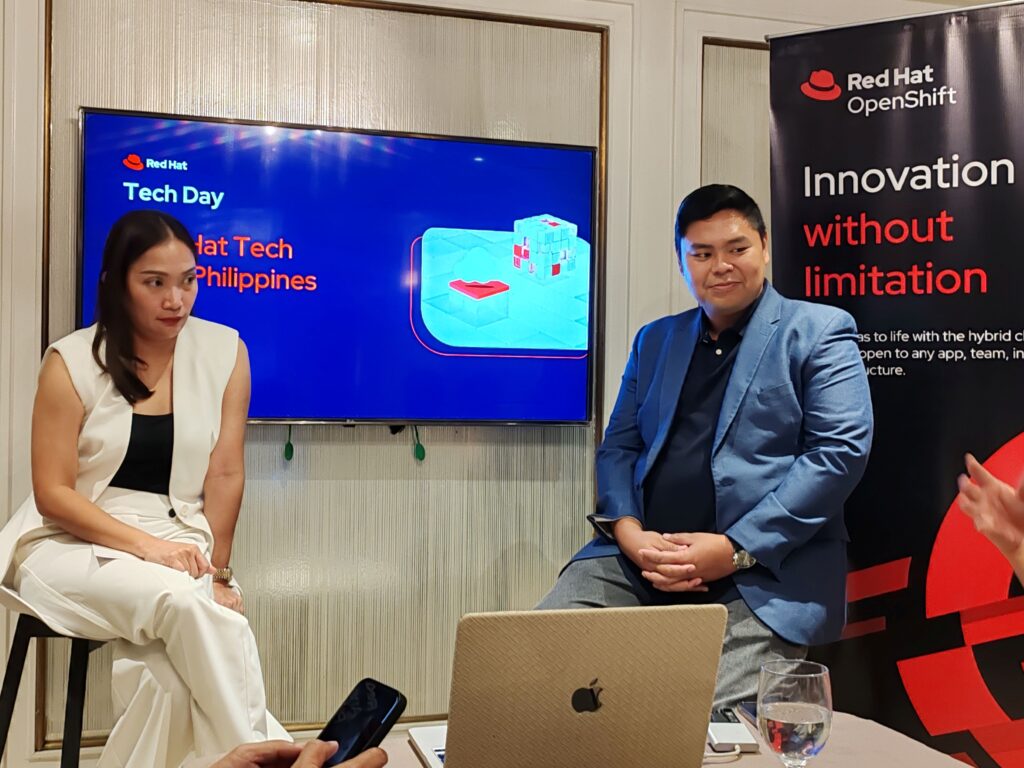
At a recent fireside chat, leaders from both organizations pulled back the curtain on how this transformation is unfolding and why open source is at the heart of it.
Red Hat’s Evolution and the Hybrid Reality
For decades, Red Hat has been synonymous with Red Hat Enterprise Linux (RHEL), one of the world’s most widely used enterprise operating systems. But today, the company’s ambitions extend far beyond Linux.
“We are an open-source company, and it’s not just about developing software. Of course, we were originally known for operating systems,” said Djang Granados, country manager of Red Hat Philippines. “You all know RHEL. That’s what we were known for. But now, we’ve evolved into more strategic portfolios.”
That evolution mirrors a broader shift in enterprise IT. Traditional proprietary software has given way to open-source models built on collaboration and shared innovation. Instead of relying on a single vendor, organizations now tap into a global community of developers who continuously improve and refine technologies.
But openness alone isn’t enough for enterprises. Companies need stability, security, and accountability. That’s where Red Hat comes in, taking community-driven innovation and making it enterprise-ready.
Backed by IBM since 2019, Red Hat has scaled that model globally, serving 90% of Fortune 500 companies and positioning itself as a leader in enterprise open source.
One of the biggest shifts in recent years has been the move to hybrid cloud, an approach that blends public cloud services with on-premise infrastructure.
While platforms like Amazon Web Services, Google Cloud, and Microsoft Azure offer immense scalability, not every organization is ready or willing to go fully cloud-native.
Red Hat’s answer lies in a portfolio designed for consistency across environments. Tools like Red Hat Ansible Automation Platform streamline IT operations through automation. At the same time, Red Hat OpenShift enables developers to build and deploy applications using containers and microservices regardless of where they run.
Nico Alina, AVP and head of infrastructure, architecture, and enablent at GCash.
GCash: Scaling at Speed
For GCash, the Philippines’ leading digital wallet, that flexibility has been critical.
When Nico Alina joined the company in 2018 as the head of infrastructure, architecture, and enablement, GCash was at a turning point. The platform was growing, but its underlying architecture needed to evolve to keep pace.
“When we started the microservices journey, a lot of it really boiled down to speed and cost efficiency,” said Alina. “From monolithic to microservices architecture, we really had to re-architect a lot of the stuff that we had back in 2018.”
Open-source tools allowed GCash to experiment, iterate, and scale without the constraints of traditional enterprise software. Early on, the team relied on platforms like Rancher to manage containerized workloads.
But as adoption grew, so did complexity. The real inflection point came in 2022.
Fresh from the COVID-19 pandemic, GCash experienced explosive growth, expanding two to three times in scale. For the infrastructure team, the challenge was immediate and intense.
At the time, GCash operated across multiple environments, with separate teams managing different cloud platforms and on-premise systems. While functional, this setup created inefficiencies and operational silos.
The solution was clear: standardization.
Today, around 99% of GCash workloads run in the cloud, primarily in Singapore. But with the help of OpenShift, the company has begun localizing some workloads in the Philippines, improving latency and resilience.
More importantly, OpenShift has allowed GCash to consolidate its infrastructure into a single, consistent platform.
The impact has been significant. Operational processes are now unified, reducing duplication and simplifying management. Teams no longer need to maintain separate skill sets for different platforms, resulting in both efficiency gains and cost savings.
For a financial platform serving millions, security isn’t optional—it’s foundational.
With Red Hat’s technologies, GCash has implemented a zero-trust architecture across its systems. Every application component is monitored, and every network interaction is subject to strict controls.
This consistency is particularly important in a multi-cloud setup, where different providers may have varying compliance requirements.
Technology with a Purpose
But for GCash, the story isn’t just about infrastructure.
It’s about impact.
“Eight out of 10 Filipinos have GCash, but we’re really trying to get the unbanked from the far-flung areas and really try to help our fellow Filipinos have financial literacy, like places without signals, places even without smartphones,” Alina noted.
To bridge that gap, GCash is rethinking how financial services can be delivered, exploring solutions that go beyond conventional digital platforms.
Looking forward, GCash aims to become an AI-native, hybrid, multi-cloud financial services organization. And Red Hat is expected to play a key role in that journey, particularly as AI capabilities become more integrated into enterprise platforms.
But even as the technology evolves, the goal remains the same: inclusion.
If there’s one theme that ties everything together, it’s this: open source is no longer just a development model—it’s a business strategy.
For Red Hat, it’s about harnessing global innovation and making it enterprise-ready.
For GCash, it’s about building systems that can scale, adapt, and serve millions.
Together, they offer a glimpse of what the future of digital finance in the Philippines could look like—open, flexible, and built for everyone.